How to Get Baby's Top Lip to Flange
Put "lip-tie" into your search engine and you volition get plenty of websites challenge information technology is the cause of breastfeeding difficulties or fussy behaviour. Notwithstanding, non everyone agrees with this view and at that place is little evidence to back up it. Who is right? Is lip-tie anything to worry about? This article discusses what a lip-tie is, whether it affects breastfeeding and answers oft asked questions.
What are tongue-ties and lip-ties?
Natural language-tie
A tongue-necktie describes the situation when the membrane (lingual frenulum) between the underside of the tongue and the floor of the oral cavity or lower gums is peculiarly short or tight and restricts the movement of the natural language. Lots of tongues have this connective tissue under the natural language but simply a few cause sufficient restriction to the natural language to interfere with breastfeeding. I have written more about tongue-tie in Tongue-Tie and Breastfeeding.
Lip-tie
There is also a membrane (called a labial frenulum, superior labial or maxillary labial frenulum) that connects the underside of the top lip to the gums1. The term "lip-necktie" describes a membrane that restricts the normal movements of the top lip. Confusingly, some people may use lip-necktie to refer to the normal presence of a membrane in this location. As with the membrane under the tongue, just because there is a frenulum nether the lip, it doesn't mean there is a problem2 3. The upper lip frenulum often changes in appearance as a baby grows and there is confusion virtually its function and significance (Santa Maria et al, 2017). An article in Global Paediatric Wellness explains:
the typical versus atypical appearance of this frenulum is not known. Nor is it known whether this frenulum has any functional consequences relating to its appearance or attachment.

What does the pinnacle lip exercise during breastfeeding?
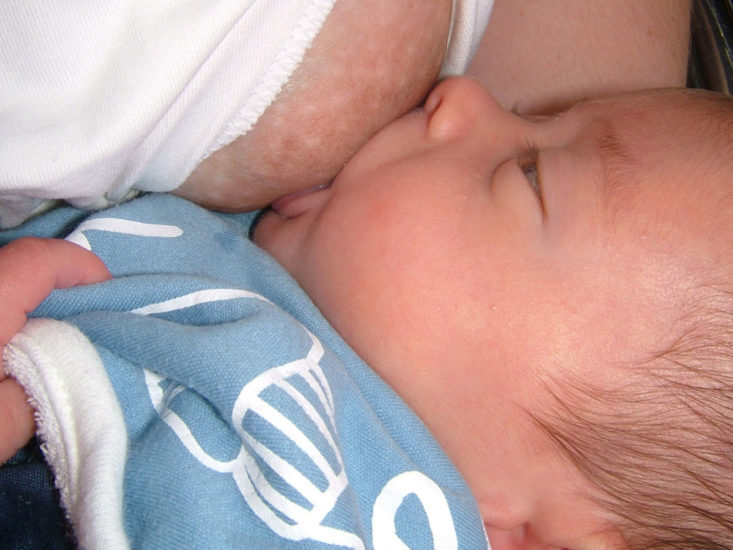
The infant's top lip rests on the breast during breastfeeding in a neutral or very slightly everted position and makes a seal around the breast four v 6. The top lip doesn't need to gape away from the gum or flare out similar the lips of a fish. The babe's top lip shouldn't demand to move up and downward, grip tightly to the chest nor curl in. If the superlative lip flares out or in that location is a pronounced crease between the lip and nose (called a nasolabial crease) this could point babe is in a shallow latch (not much breast tissue in baby's mouth) or positioned too high at the breast with more of the pinnacle lip over the breast than the bottom lip below information technology.
Do lip-ties affect breastfeeding?
Given the function of the height lip during breastfeeding—to rest on the breast and brand a seal—the position of the frenulum under the height lip is unlikely to be a cause of breastfeeding problems for the majority of mothers and babies. Cathy Watson-Genna discusses that a very tight lip frenulum could produce a sucking blister on the mucosal surface (underside) of the upper lip which might make information technology more difficult for a baby to stay fastened7. Even so there can be other causes of a sucking blister from unproblematic positioning to the use of certain canteen teats.
No evidence
There are many reasons why breastfeeding might hurt, why a mother might take low milk supply or why a baby might not proceeds weight or have wind just currently in that location is no bear witness or agreement that a "lip-necktie" is an important factor in any of these8 9 x 11 12.
Faulty rationale?
The idea that lip-ties tin influence latch seems to depend on the belief that the upper lip must exist turned out, or flanged, during breastfeeding. This assertion is readily adopted by fee charging practitioners. However, breastfeeding specialists and lactation consultants know that while it is desirable for the lower lip to be turned out against the breast, this is not necessary or desirable in the upper lip. It may work for some babies of class, simply it isn't a goal or dominion to strive for.
What if my baby's top lip is rolling in, moving up and down or losing suction during feeding?
There are several reasons to explain why a baby's top lip might whorl in, overly grip the breast, lose suction or be moving excessively and seem to crusade pain. Any of these could exist confused with "lip-tie" still other explanations include:
- Unstable positioning. If a babe doesn't feel stable they may try to hold on to the breast with their lips to give them more stability. You may notice your babe has a sucking blister on his elevation lip if he is using information technology excessively (Watson Genna, 2016). Adjusting babe's position so their whole torso is supported can help with this and keeping baby closer to the chest tin reduce movement and hence friction with each suck.
- Shallow latch. If a babe is in a shallow latch (has mostly nipple in their mouth and not much chest tissue) or has more of the superlative lip over the breast than the lesser lip is below it, baby'due south tongue may not move optimally and the lips may endeavour to compensate. Sometimes a babe's or female parent's beefcake makes it more difficult to become a deeper latch east.g. a receding chin, pronounced upper lip or a large nipple.
- Adjustments needed. Sometimes a baby volition latch with their upper and/or lower lip curled in simply simple adjustments tin can ofttimes be made to correct this after the latch. A little breast milk to moisten the latching area may be helpful. Many lower lips can be gently everted with fingertip pressure to the baby's chin and similarly the upper lip can exist encouraged out with a finger if it is rolled in.
- Tongue-tie. If a baby has aberrant tongue movements or a natural language-necktie, he may overwork his lips to recoup for poor tongue function.
- High muscle tone. A infant with high muscle tone might have a lot of tension in their lips. Excessive lip tone may be associated with a neurological event or an injury of the jaws, tongue or facial nerves13. Loftier lip tone tin also be associated with poor positioning or nipple confusion from canteen feeding and might cause nipple damage and affect milk transfer14.
- Depression tone, losing suction. Losing suction at the chest or spilling milk from the lips tin can be associated with weak lip tone or generalised low musculus tone (hypotonia). This can cause a baby to become quite tired at the breast and take in less milk15. Other possibilities to consider include underdevelopment of the facial nerve, nervus damage or facial asymmetry16.
- Breathing difficulty, congestion. Difficulty breathing through the nose may cause a baby to let get of the chest in gild to breathe through their mouth.

It'southward not just virtually the lips!
If breastfeeding hurts, a breastfeeding specialist can help you with positioning and see Breastfeeding Positions for Newborns, Latching Tips and Why Does Breastfeeding Hurt?
Why is everyone talking nigh lip-necktie?
Worried parents searching for breastfeeding answers on the internet (particularly on Facebook) are oftentimes being told that their babies might have lip-ties. These internet advisors have non seen the baby breastfeeding or taken a medical history. They are usually not medically trained nor breastfeeding specialists. Many are using the term "lip-tie" to refer to a normal upper lip frenulum. Simply because there is almost certainly a frenulum under a baby's top lip, and merely considering in that location are health professionals in some countries who are happy to surgically remove information technology for a toll, this does not mean your baby has anything other than normal anatomy. Without a proper assessment by a breastfeeding specialist to cheque positioning and attachment, there is a run a risk of unnecessary, painful and expensive procedures existence carried out on babies with no benefit to breastfeeding.
The chief justification for these procedures is to facilitate and improve breastfeeding; however, there is little bear witness that certain appearances of the labial frenula have any bearing on latching or feeding.
What about parents who say having their babies lip-tie cut helped pain/wind/weight gain?
Some mothers feel removal of the labial frenulum helped feeding in some mode and become violent advocates for the procedure. Comport in mind the baby may accept had both a natural language-tie and the lip frenulum divided at the same time. If breastfeeding comfort improved after both procedures it was almost likely due to division of the tongue-necktie. In some cases, the process might assist a baby compensate for the real underlying issue. Sarah Oakley, IBCLC explains:
The added ability to fully flange the meridian lip will allow a baby to compensate for continued poor positioning or tongue function bug. Merely of course this is treating a symptom and non the underlying crusade. Improving positioning, tongue –necktie division, tongue exercises and suck grooming to promote constructive tongue mobility would be more appropriate.
Conversely, if infant had been overworking the upper lip, a painful wound on the inside of the upper lip might prevent him using that compensation after the procedure.
Can lip-necktie cause tooth decay?
If it is difficult to clean a baby'southward front teeth due to a frenulum that tin trap food or a frenulum that prevents the top lip from beingness lifted to clean the teeth, this could be associated with dental caries. Withal, as the labial frenulum changes over time, it may not be a problem by the time your baby has a full set of teeth (Santa Maria et al, 2017). Careful attention can exist paid to cleaning the front end teeth and any concerns can exist discussed with your kid's dentist if bug arise. The Australian Dental Association says there is not plenty bear witness to support the idea that a brusque or tight upper lip frenulum could increase the run a risk of molar decay (ADA, 2020)
Can lip-tie cause a gap in the forepart teeth?
The Australian Collaboration for Infant Oral Research (ACIOR) says that the presence of a prominent midline lip frenulum does not predict tooth spacing subsequently17. Nagveni et al explain:
Labial frenum is a dynamic and often child-bearing construction and is subject to variation in shape, size, and position during the different stages of growth and development. During growth, information technology tends to subtract in size and lose clinical importance. In young children, the frenum is mostly wide and thick, and during growth it becomes thin and pocket-size
The Australian Dental Association agrees in that location is not plenty evidence to support the idea that releasing an upper lip frenulum could prevent a gap between the top two teeth or help with other orthodontic issues (ADA, 2020).
What is the handling for lip-tie?
The labial frenulum is removed by laser or via cutting in a surgical procedure. Potential risks include:
- Haemorrhage if scissors frenotomy (mitigated by use of laser)
- Unnecessary pain and distress
- Wound infection
- Oral aversion resulting in worsened feeding issues in infant with pre-existing breastfeeding or feeding problems
- Underlying feeding/breastfeeding problems remain unidentified and unmanaged
- Worsened diastema of upper incisors in afterwards childhood due to scarring
Wound care
Some practitioners tell parents to regularly stretch the wound to prevent a frenulum from reforming. This is painful for babies and upsetting for parents whether under the tongue or under the lipeighteen. A consensus argument from a range of wellness professions was coordinated by the Australian Dental Association. They country at that place is no scientific evidence to support stretching surgical wounds and that this kind of "active wound care" prolongs healing and increases the hazard of infection and scarring (ADA, 2020).
Has my lactation consultant missed my baby'due south lip-tie?
Your lactation consultant volition be able to gauge what your baby is doing with his lips and tongue by watching a breastfeed, not only because of the appearance nether your baby's lip. They will spend fourth dimension talking to y'all nearly your medical history and breastfeeding feel. Your lactation consultant volition make suggestions to ameliorate positioning or know when to refer you back to your GP, paediatrician or natural language-tie practitioner. If you're nonetheless finding breastfeeding painful or difficult, go dorsum in touch with your breastfeeding specialist and let them know. The more you tin tell them, the better they volition be able to assist you.
What practice independent experts say?
The Association of Natural language Necktie Practitioners (ATP) in U.k. say:
Currently at that place is no published evidence supporting a link between breastfeeding problems and lip necktie.
The National Institute for Health and Care Excellence (NICE) have non issued whatsoever guidance on this effect and therefore grooming is non available in the United kingdom of great britain and northern ireland in lip tie partition for practitioners.
This state of affairs may alter in the future if new research and evidence influences best practice guidelines. Currently nurse/midwife tongue-necktie practitioners working in the UK cannot offering lip tie division as the Nursing and Midwifery Council's Code of Comport states that nurses, midwives and wellness visitors must 'deliver intendance based on the best available testify or all-time do' and ensure whatever advice given is testify based if suggesting healthcare products or services.
The Australian Collaboration for Infant Oral Research says:
We recommend no intervention, as maxillary labial and buccal frena ["cheek ties"] are normal anatomic variants and practice not 'tie down the upper lip' to bear on on breastfeeding or feeding function. Unnecessary anxiety is created for parents when a normal anatomic variant is labelled as a 'tie'.
What exercise the books say?
Many breastfeeding reference books do not incorporate sections about lip-tie suggesting it is a new theory to explain breastfeeding difficulties and that in that location is a lack of robust testify associating it with breastfeeding issues. The fourth edition of Breastfeeding Management for the Clinician goes forth with the idea that the upper lip must flange out and associates poor latch with lip-tie.
The Breastfeeding Atlas, 6e explains that the labial frenulum is normal anatomy, gives stability to the upper lip and has many variations in advent. The authors say:
There are case reports of an consequence on breastfeeding of thick upper labial frena, but no evidence upon which to base practice with regard to identifying infants who might require surgical correction. Poor positioning, abnormal musculus tone, or an association with an underlying syndrome could provide, in some cases, a better explanation for why an infant feeds poorly.
Summary
A frenulum under the superlative lip is normal anatomy providing stability to the upper lip. Information technology changes over time tending to become thinner and smaller as baby grows. There is insufficient bear witness that sure appearances of this frenulum can cause difficulties breastfeeding. The upper lip plays a relatively minor role during breastfeeding. Despite this, it has go fashionable amongst some parents to arraign "lip-tie" on all mode of breastfeeding issues, aggressively then in some cases. Parents are being urged by other parents to have their baby's lip frenulum removed. The rationale upon which the statement is based—that the upper lip must flange during breastfeeding—is not supported past lactation consultants who work with breastfeeding mothers every day. There is no long term inquiry on the implications of removing the labial frenulum in a newborn. Parents should be aware that breastfeeding forums on social media should not exist a substitute for skillful face-to-face support with a breastfeeding specialist.
lockettdepastakeely.blogspot.com
Source: https://breastfeeding.support/lip-tie-and-breastfeeding/
0 Response to "How to Get Baby's Top Lip to Flange"
Post a Comment